16 DEC 2025
Concordia Damen calls for a rescue plan for small inland shipping through the construction of new small vessels and a boost for electric propulsion
Chris Kornet: “Together we must prevent 40 million tonnes of cargo from leaking away!”
“By investing in smaller green vessels powered by fixed or swappable battery packs, and by simultaneously developing a network of charging stations at key locations along inland waterways, we can prevent a market of 40 million tonnes of cargo from shifting to road transport as small vessels disappear,” says Chris Kornet, CEO of Concordia Damen Shipbuilding. He advocates the introduction of incentive schemes that provide additional stimulation for newbuilds up to 86 metres and for electric navigation.
Every year, dozens of small vessels leave the fleet due to scrapping. Kornet considers it a positive step that the government is granting permanent exemptions from technical requirements to Spits, Kempenaar and Dortmunder vessels. “This will slow the decline, but it will not stop it. A better approach is to encourage newbuilds up to 86 metres (and one slightly larger type) again through a replacement scheme. As of 2025, virtually all new construction takes place from 110 metres upwards.”
The shipbuilder from Werkendam welcomes the fact that the government will soon subsidise fixed battery packs. This creates new opportunities for smaller vessels to operate electrically—either zero-emission or hybrid—over shorter distances.
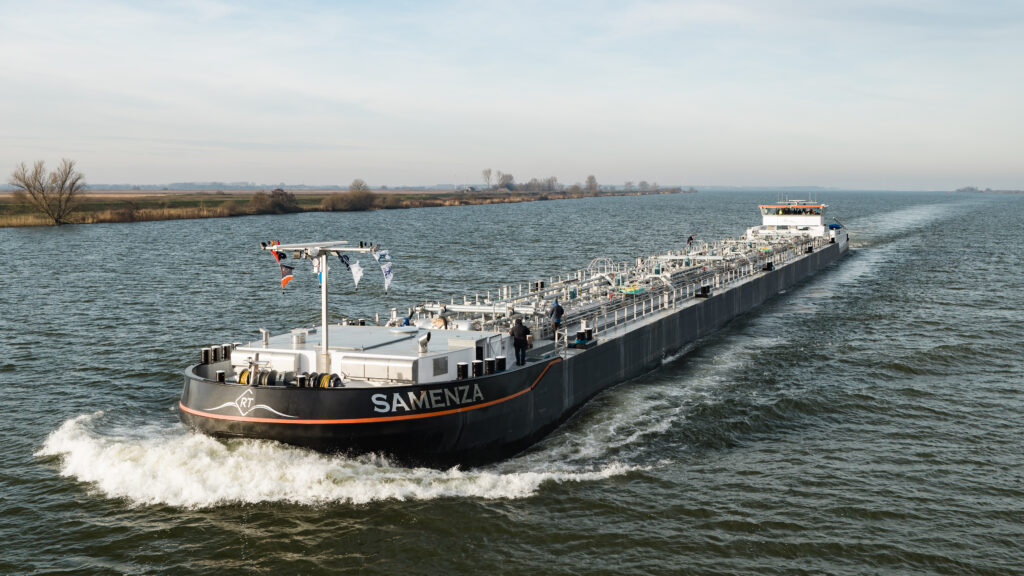
Concordia Damen has several electric dry cargo vessels and tankers of 86 metres on the drawing board. With the current fixed battery storage capacity, these vessels can sail 300 to 400 kilometres per day and recharge overnight. The same applies to dredgers, hopper barges and crane vessels.
At the same time, Kornet calls for faster expansion of the ZES container network by allowing the swappable ZES battery packs to remain on board as fixed packs and to be charged there. ZES (Zero Emission Services) is currently continuing to build its ecosystem for sustainable inland shipping: a system of swappable battery containers and a network of open-access charging and swapping stations along various inland routes.
Vessels that need to cover longer distances can supplement fixed battery packs with solutions based on HVO (Hydrotreated Vegetable Oil), hydrogen or methanol. “In this way, we give new momentum to greening inland shipping and we are still in time to prevent cargo from being lost to road transport,” Kornet concludes.
Concordia Damen urges the government to promote electric navigation far more vigorously than is currently the case and invites inland shipping entrepreneurs to jointly explore subsidy opportunities under the new Energy Transition Scheme 2026 (Early Scaling) and the second call of the Maritime Master Plan.